

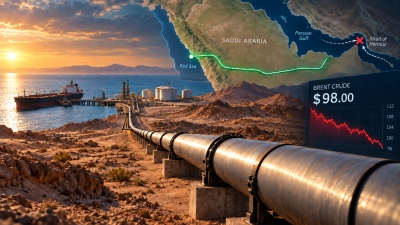
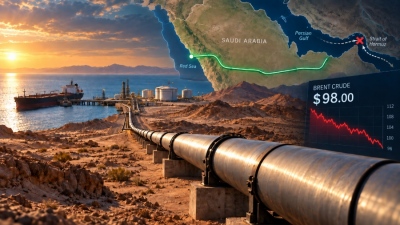
At an extraordinarily critical juncture for the global energy market, Saudi Arabia announced it will put the strategically vital East-West pipeline back into operation. The pipeline connects oil fields in the kingdom's east to the port of Yanbu on the Red Sea, bypassing the critical Strait of Hormuz. In the wake of the news, Brent crude fell 1.83% to $98.50, recording losses of nearly 6% over the course of the week. Attention now turns to how quickly flows will be restored and how much additional Saudi oil can reach international markets without needing to pass through Hormuz.
The reopening of East-West
According to information from international media outlets, the pipeline will resume operation by the end of the week, although Saudi Aramco has not—at present—made official announcements. Traders are also selling oil as they estimate that diplomatic meetings taking place this week between Iran, China, and the US could lead to potential progress in efforts to end the Middle East conflict. Oil prices had spiked to as high as $107 a barrel after Saudi Arabia halted operation of the East-West pipeline nearly two weeks ago following a series of drone attacks that destroyed pumping stations and caused several injuries.
The role of East-West
The 1,200-kilometer East-West pipeline stretches from the kingdom's primary oil fields in the east to the port of Yanbu on the Red Sea in the west. It has allowed Saudi Arabia to continue oil exports despite Iranian attacks on vessels transiting the Strait of Hormuz, the primary maritime route for transporting oil from the Persian Gulf to the rest of the world. It remained unclear how much oil could be funneled through the pipeline once it reopens. Its official capacity stands at approximately 7 million barrels per day. June Goh, an analyst at Sparta Commodities, stated that if just one-quarter of the flow through the pipeline is restored, there will be no additional oil exports, as those quantities will be consumed by Saudi Arabia's own refineries on the west coast.
If 40% of the pipeline capacity is restored, then, according to her estimate, an additional 1 million barrels of crude oil per day could be added to the market. A large portion of the oil moved through Yanbu is directed to European markets, though European refineries were informed last week that they would not receive shipments scheduled for October. "The shutdown of the East-West pipeline altered the geography of Saudi exports within two weeks," noted analysts from energy data firm Kpler, highlighting that the kingdom rapidly redirected its oil exports through the Strait of Hormuz following the pipeline's destruction. Analysts noted that loadings from the port of Juaymah had increased fivefold compared to the August rate, and that on September 20 every berthing station at the port was occupied.
Meanwhile, on the US-Iran front, Tehran denied reports regarding a unlocking of Hormuz. Specifically, Iran was reported to be open to the possibility of reopening the strait within seven days, provided there is a relief of American military pressure and an end to the blockade of Iranian ports.
US pressure for a total shutdown
Furthermore, US Treasury Secretary Scott Bessent told CNBC earlier that Washington is exerting pressure on Iran "like never before." He warned that starting tomorrow, Wednesday (9/23/2026), Iranian airlines risk a total shutdown, explaining that any provider offering fuel, ground handling services, or tickets to Iranian aircraft will be cut off from the global dollar system. As part of this strategy of economic isolation and targeting Tehran's financial enablers, the US Treasury Department announced new sanctions last week against state-owned Russian VTB Bank. However, the scene is further complicated by the actions of Houthi rebels. The G7 countries unequivocally condemned the armed group's "unacceptable and ongoing attacks" against Saudi Arabia and Yemen, demanding an end to all military action and the cessation of Iranian support for the organization. It is noted that the Houthis recently claimed responsibility for strikes on sensitive targets in Riyadh, while the capture of Perim Island in the Red Sea gives them additional control over the Bab el-Mandeb Strait, a critical alternative oil export route—especially for Saudi Arabia via the East-West pipeline—making visible the risk that Iran and its allies could simultaneously control two vital global energy choke points.
www.bankingnews.gr









Σχόλια αναγνωστών